 Turkey (Turkish)
 Germany (German)
 Worldwide (English)


True tenant scope
Organization identity scopes location, task, payment, reporting, API, webhook and operations data. Users can be restricted at organization, brand, region and location level.

 Halkali merkez neighborhood fatih st ozgur apt no 46 , Kucukcekmece , Istanbul , 34303 , TR
LocationHub combines organization isolation, platform listing tracking, data quality audits, task-approval-SLA operations, bulk and pilot-free location migration, provider takeover management, a sales CRM pipeline, an SEO page engine, AI-assisted review analysis, 9 payment providers, reporting, API and licensing workflows in one PHP application for multi-location brands, agencies and SaaS entrepreneurs.
Automated publishing availability depends on each provider’s API access, partner approval and connection configuration.
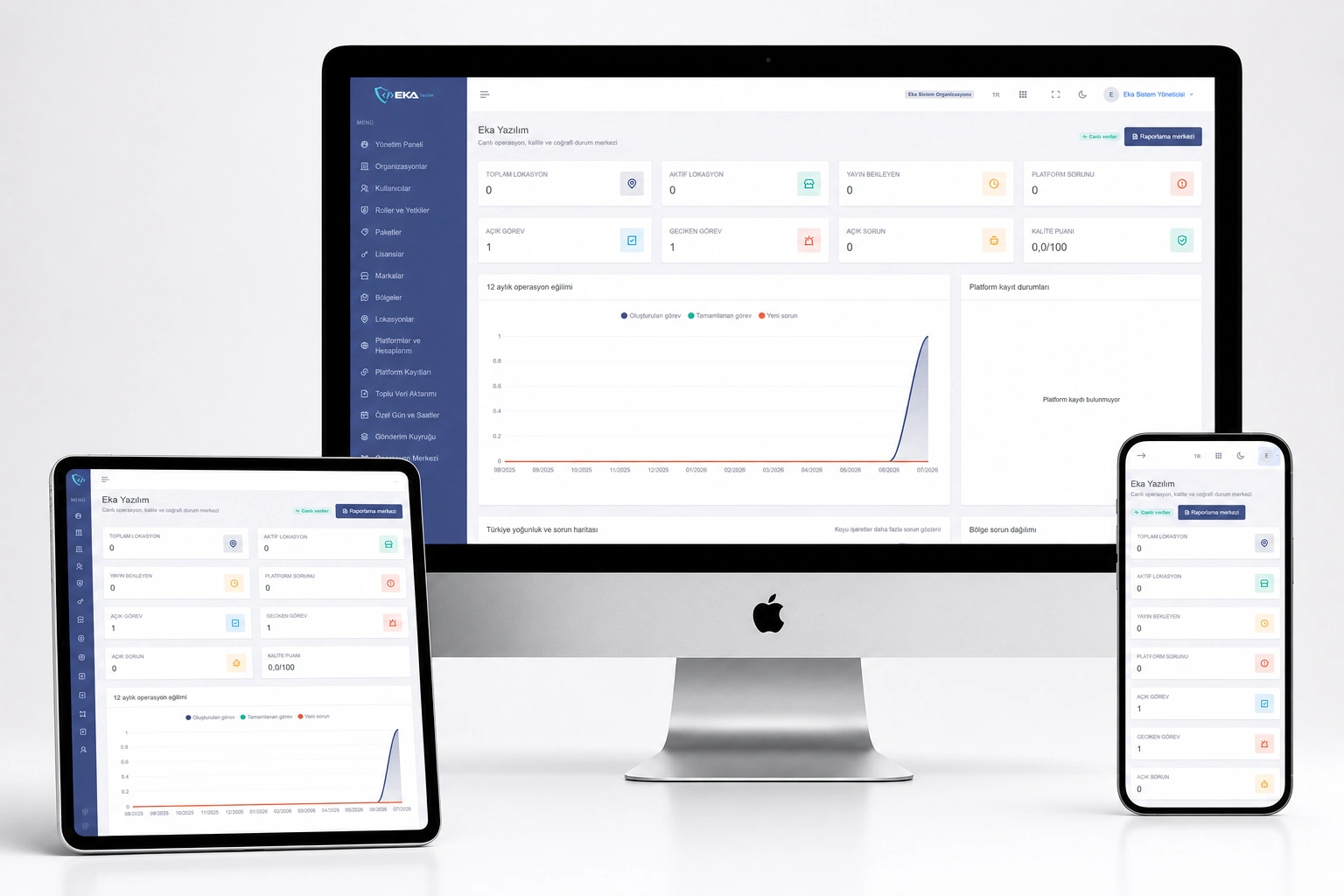
The actual scope was analyzed across 144 relational tables, 332 foreign keys, 111 tenant-scoped tables, 99 migrations, 130 permissions, 17 built-in roles, 61 service classes, 42 controllers and 435 routes. The features below are based only on modules directly represented in the database and codebase.
Organization identity scopes location, task, payment, reporting, API, webhook and operations data. Users can be restricted at organization, brand, region and location level.
Official API, partner, file and manual methods are modeled in one center. Each platform record stores status, external ID, URL, data differences, evidence, correspondence and history.
Missing fields and issues are scored per location. Duplicate candidates with similarity scores are reviewed, while scheduled audits measure data freshness.
Multi-step approval, SLA, task checklists, time entries, issue management, activity logs and evidence tracking make every change traceable by owner and time.
A product that does not end at the sale: a sales CRM pipeline, revenue-model catalog and dynamic SEO page engine work together in the same database, from contract opportunities to SEO-driven customer acquisition.
Card data is never stored on the server; real signed-webhook verification, commission and VAT logic for providers like PayTR, iyzico, Stripe and Shopier are managed in the same provider data model.
For each platform, store connection method, credential fields, external record, status, data differences, errors, evidence, correspondence, suggested edits and last-action times.
Manage customer organizations, contract periods, trials, plans, location-user-brand-API-storage quotas and account status from one center.
Define brands, parent brands, categories, corporate colors, logos, default business hours, naming rules and description templates.
Build nested regions, assign regional owners and restrict users to their authorized geographic scope.
Store branch and ERP codes, location type, store format, tags, description, owner, opening, closure, relocation and old-new location relationships in one record.
Store address, district, city, postal code, country, latitude-longitude, phone numbers, email and website in separately verifiable fields.
OpenStreetMap and Esri satellite layers are supported by a data model ready for coordinate verification and visual positioning workflows.
Manage open-closed, 24-hour, opening and closing values separately for every day and location.
Target holiday, campaign or event hours to multiple locations and track planning, approval and application results separately.
Manage Google, Apple, Yandex, HERE, Bing, OpenStreetMap, TomTom, Foursquare, Waze and navigation ecosystems in one catalog.
Define dynamic credential fields, required and secret flags, validation patterns, help links and connection-test status for each platform.
Track external record ID, platform URL, central-platform data, differences, errors, operational notes and last send, publish and check times.
Attach screenshot, document or source URL evidence and store support or verification correspondence with channel, subject, external reference and date.
List platform-originated suggestions with current and proposed values; authorized users record acceptance, rejection and decision notes.
Store missing fields and inconsistencies as a score, issue list and missing-field list in automated audit results.
Place potential duplicates in a decision queue using similarity scores and matching fields; store merge or keep-separate decisions with notes.
Change requests with old-new data comparisons pass through role-based steps, time targets and user decisions.
Location- or platform-linked tasks include owner, priority, department, tags, checklist items, comments, time entries and activity history.
Track issues with category, source, priority, due date and resolution notes; calculate SLA targets using working calendars and warning thresholds.
Manage CSV/XLSX operations with column mapping, preview, row validation, error reporting and new-updated record counts.
Schedule CSV, XLSX, PDF and JSON reports and track recipients, frequency, files, record counts and email delivery results.
Includes scoped API keys, IP restrictions, per-minute limits, request logs, latency measurement and idempotency for duplicate write protection.
Run integration operations with signed webhooks, retries and delivery logs plus ERP connections, field mapping, schedules, tests and sync results.
Manage panel, email, SMS, webhook and WhatsApp preferences through event, language, template, provider, queue and retry layers.
PayTR iFrame, PayTR Bank Transfer, iyzico, Stripe, Shopier, Garanti/Ziraat/Akbank virtual POS and bank transfer share one provider model. Each provider supports an optional commission rate, and VAT rates are managed from the panel instead of being hardcoded.
VAT orders, itemized invoices, payment notices, customer credits and license periods are completed with bank-transfer notice approval/rejection and automatic credit issuance.
Includes two-factor authentication, password policy, failed-login lockout, session logs, password reset, encrypted credentials and detailed activity logs.
Includes SHA-256 verified backup, restore and deletion plus module catalog, dependencies, versions, signatures, review, deployment and rollback backups.
Manage corporate pages, slugs, metadata and OG images with sitemap/robots infrastructure plus a brand center for logos, favicon, colors, panel and landing copy.
Turkish and English language seeds are ready, with a data model designed to extend languages, translation keys and texts from the panel.
A 14-stage migration project and 17-item checklist for customers taken over from an existing provider, tracking contract dates, owners and a real inventory summary in one screen.
Bring thousands of stores live simultaneously without a pilot rollout, using pre-checks, a queue and partial-success logic; supports pause/resume and field-level rollback.
Rules driven by star-rating thresholds, critical keywords and platform/store-group filters automatically turn matching reviews into critical tasks or route them to AI analysis.
Reply templates matched by brand, language and star range pass through a draft-pending-approved workflow; bulk CSV import migrates existing template libraries in one pass.
Combines review, campaign, image, duplicate-candidate, open-task and SLA data for every location in one dashboard, with 30/90/365-day comparisons and PDF/Excel export.
Weekly campaign count, target store/platform volume, pending approvals and delay risk are calculated from real data, with a staffing estimate linked to the quoting process.
A 14-stage sales pipeline from quote request to won/lost outcome, with every status change logged in history; opportunities can also be opened manually from the panel.
Recurring passive line items (extra location, user, API quota, storage, AI credits) and one-time active items (onboarding, data migration, account transfer) are managed in one catalog. Exceeding a contract limit can automatically open a sales opportunity.
Product, service, audience and guide-type pages are managed from the panel with JSON-LD schema, internal-link relationships, and sitemap/robots integration. 33 original content pages are currently live.
Connect any OpenAI-compatible provider (OpenAI, Groq, OpenRouter, Hugging Face, Cloudflare AI and more); the real model list is scanned live and system prompts are editable from the panel. Without a connection, rule-based analysis takes over, so no fabricated results are ever produced.
Schedule and publish posts to connected Facebook and Instagram accounts through real Graph API calls, and reply to incoming messages and comments from the panel.
A readiness score for visibility in AI search engines like ChatGPT and Perplexity is calculated from real database signals for each location; an AI connection adds an extra awareness check.
Only locations explicitly marked as publicly listed appear on a session-free public search and map page.
The protected Demo Mode Role allows viewing only; record creation, updates, deletions and raw SQL backup downloads are centrally rejected server-side.
LocationHub does not promise unconditional automatic publishing to every platform. The actual method for each provider is defined as API access, partnership, file format or manual operation, keeping product claims aligned with technical reality.
Define customer, contract, trial, quotas, brands and user scope.
Map CSV/XLSX columns and process new or updated records after preview and row validation.
Score missing contacts, addresses, coordinates, hours and potential duplicates, then send them to decision queues.
Choose a connection method and track platform records, differences, evidence, correspondence and suggested edits.
Assign field tasks and complete them with checklists, time tracking, SLA and multi-step decisions.
Deliver controlled data to internal systems through scheduled reports, notifications, REST API, webhooks and ERP queues.
Use the demo account to review organization, location, platform, task, reporting, payment and system interfaces. The SQL architecture includes a dedicated protected Demo Mode Role.
[email protected]demoCentrally manage addresses, phones, hours, map listings and quality control for large branch networks.
Manage special hours, temporary closures, relocations and regional operations from one panel.
Standardize distributed location networks by brand, region, store format and owner.
Turn multi-client location operations into a service with tenant isolation, tasks, evidence and reports.
Build your own plan-based location product with quotas, payments, orders, invoices and license lifecycle.
Manage change requests with role-based approvals, SLA, activity logs and report delivery.
Before installation, verify PHP version, extensions, database version, HTTPS, cron and write permissions. Regular backups and two-factor authentication are recommended for production.
Get Installation GuidanceYes. Organization membership and organization identity scope location, task, payment, notification, report, API, webhook and operations data. Access can also be restricted by brand, region and location.
The SQL architecture contains 22 active platform definitions, including Google, Apple, Yandex, HERE, Bing, OpenStreetMap, TomTom, Foursquare, Waze and navigation/device ecosystems.
The catalog supports official API, partner, file and manual transfer methods. Actual automated publishing depends on provider API access, partner approval and configured credentials.
The model includes platform accounts, dynamic credential fields, external record IDs, URLs, central and platform data, differences, send-publish-check times, errors, evidence, correspondence and suggested edits.
Upload a file, map columns and generate a preview. Each row is processed as valid or invalid; new and updated records and errors are reported separately.
The payment provider model includes PayTR, PayTR iFrame, Stripe and bank providers. Webhook, idempotency, payment, bank account, transfer notice, order, VAT, invoice and licensing records are designed as one lifecycle.
The system manages monthly/yearly plans, order periods, payments, invoices and license renewal dates. Provider-side recurring card collection requires the relevant recurring/token capability to be configured separately.
The application database includes active Turkish and English language seeds. Language and translation tables are ready for panel-based expansion. This product page is available in Turkish, English and German.
The database includes a protected Demo Mode Role. Demo actions can be restricted by application policy to protect live data.
Use Nginx or Apache with PHP 8.3+, MySQL 8.0+ or MariaDB 10.5+, required PHP extensions and writable storage, logs and uploads directories. It can be hosted on cPanel, Plesk, DirectAdmin, ServBay and Docker environments.
The database schema defines 9 provider types: PayTR iFrame, PayTR Bank Transfer, iyzico, Stripe, Shopier, Garanti/Ziraat/Akbank virtual POS and bank transfer. Each provider supports its own commission rate, active/inactive status and panel-managed VAT rate.
No. Under the Demo Mode Role, every write request (including record creation, updates and deletions) and raw SQL backup downloads are centrally rejected server-side; only viewing is allowed.
The provider migration management module tracks the process with a 14-stage project and a 17-item checklist. Go-live can be executed simultaneously, without a pilot rollout, using a bulk migration orchestration engine built on pre-checks and a queue.
The dynamic SEO page engine is managed from the panel with JSON-LD schema, internal-link relationships and sitemap/robots integration; 33 original content pages ship with the install, and new pages can be added with the same engine.
Yes. A 14-stage sales opportunity pipeline starts from quote requests, every status change is logged in history, and opportunities can also be opened manually from the panel.
Any provider compatible with the OpenAI Chat Completions contract (OpenAI, Groq, OpenRouter, Hugging Face, Cloudflare AI and more) can be connected, and the real model list is scanned from the panel. Without a connection or on error, the system falls back to rule-based analysis and never displays a fabricated result.
Review the demo panel and contact our sales team about platform scope, installation, licensing and project-specific integrations.